
When Music Helps Us Say Goodbye
Hello and welcome,
This month’s Music & Memories Notes is a little more personal.
In August, my dad passed away.
For the last four and a half years since his Alzheimer’s diagnosis, I had the privilege of being part of the team helping Dad stay in the place he loved most - his home on the hill in Toodyay.
Music became a very special part of that time together.
I played my guitar and sang with him and his friends at the Toodyay Bakery Forget Me Not Dementia Cafe. At other times we would get together with his friends or his brother for a “sing song” sing along.
And many times, Dad sat at his kitchen table listening and singing along while I practised songs for aged care Music & Memories sessions or church services. These weren’t grand occasions. They were ordinary moments around a kitchen table. Looking back, they are some of my most precious memories.
And at the end of Dad’s life, music became something else. Not an activity. Not a performance. Just a way for us to connect and be together. A guitar, some of Dads favourite songs, music wafting through the room and hospital corridors.
It reminded me why connection matters so much and how much it means when the staff caring for someone support that opportunity to connect.
Music & Memories Moments: Bringing Home into the Room
When Dad was in hospital and we were told he wouldn’t be going home, we wanted to bring a little of the place he loved into his room.
Dad’s property in Toodyay was surrounded by the sounds of the Australian bush. So, we played recordings of birdsong - magpies, kookaburras and pink and grey galahs.
For a little while, the hospital room held the familiar sounds of home.
We weren’t looking for a reaction. We were simply bringing something of Dad’s world to him.
And then the hospital staff gave our family a private room so we could be together with Dad and say goodbye in our own way.
We sang. We laughed. We cried.
There was no performance, and nobody needed to sing beautifully. They were simply the songs Dad loved and voices of people who loved him.
It was heartbreaking, but it was also beautiful.
I have spent years sharing music with residents in aged care. But being there as a daughter gave me a new appreciation for the care that staff offer residents and families at this time.
The privacy we were given, the respect for Dad, and the understanding that a family might need space to laugh as well as cry - those things mattered enormously.
Not every family will want music, and not every goodbye will look like ours. What mattered was that the staff made space for our goodbye.
Try this: Bring a Little of Home into the Room
When someone is receiving palliative care, music does not need to be a planned session. A familiar song, voice or sound may offer a small moment of connection. And sometimes the kindest choice is quiet.
You may already be doing many of these things. Here are a few gentle questions that can help you learn what feels right for this particular resident and family.
If a resident can tell you their wishes, start there. Otherwise, speak with the people who know them well, and work with the care team and the resident’s care plan.
You might ask:
- Is there a favourite song, singer, hymn or piece of music they have always loved?
- Did they used to have the radio on in the background at home?
- What sounds remind them of home - birds in the garden, waves at the beach, the farm?
- Did the family have songs they used to sing together?
- Would music feel welcome now, or would you prefer some quiet time?
Then keep it simple:
- Offer one familiar song or a short recording, at a gentle volume.
- Check that the resident and family are comfortable with what is being played.
- Pay attention to their cues, and pause or stop if the sound seems unwelcome or distressing.
- Leave space for conversation, laughter, tears, rest and silence.
There is no need to get a response. Someone may smile, hum or move a hand. They may show nothing we can see. The aim is not to make something happen; it is to offer something familiar, with care and respect.
Connection Is in the Small Things
When I think about the hospital staff who cared for Dad, it is the little things I remember. They helped us have privacy, gave us room to be ourselves and let us share those last moments in a way that felt right for our family.
You already show this same respect, love and understanding every day.
You listen when a family wants to tell you who their loved one has been. You remember the small details that matter to a resident. You make room for a familiar voice, a hand to hold, or a moment together, even in the middle of a busy day.
Those gestures may seem ordinary when they are part of your work. From the family side, they are anything but ordinary.
Connection is not always about doing more. Sometimes it is about noticing what matters to the person in front of you and making space for it.
Questions & Answers
Q: What if a song makes someone cry?
A: Tears do not automatically mean something has gone wrong. Love, sadness and memory often sit together. But don’t assume the music is comforting either. Gently check if they would like it to continue, and follow their wishes and cues.
Q: Can music matter when a resident is no longer communicating verbally?
A: It may still be meaningful to offer something familiar, but we cannot always know what the person is experiencing. Ask those who know them, keep sound gentle, follow the care plan and watch for signs that they seem unsettled. There is no need for a visible response.
Q: What if a family wants to sing but feels self-conscious?
A: Remind them a familiar voice matters more than singing in tune. Equally, they do not have to sing. Talking, reading out loud, playing a recording, holding a hand or sitting together quietly are all valid ways of being present.
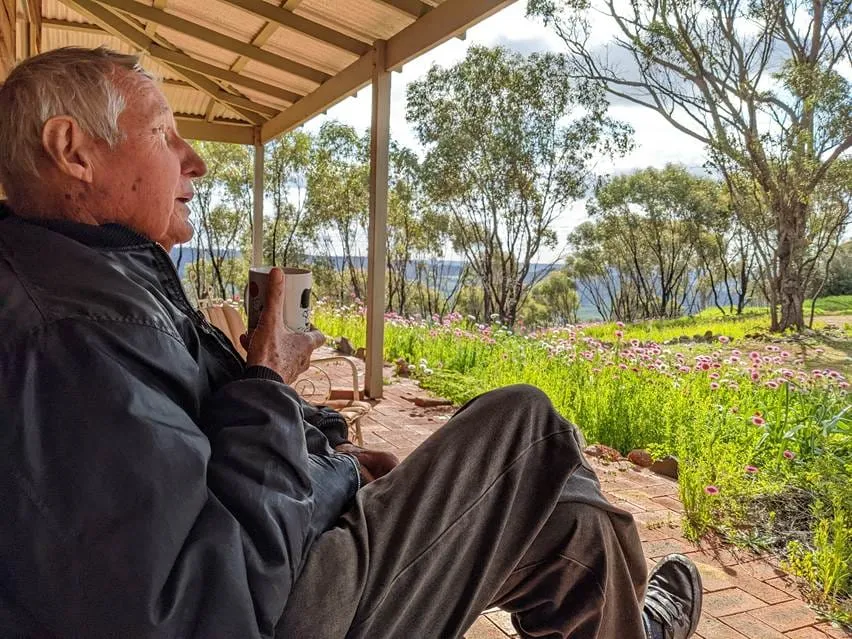
When I think of Dad now, I see the man sitting on his verandah overlooking Toodyay. The kind man who drove a wheelchair taxi. The cheeky man who made us laugh. The man getting sloppy kisses from our dog Luna. And Dad at his kitchen table, listening while I practised another song on my guitar.
Music did not take away the sadness of losing him. But it gave us a way to share something that had been a special part of our relationship.
And the kindness of the hospital staff gave our family the space to do that.
To all of you who help a resident and their family feel respected, loved and understood: thank you. I know you already bring these qualities to your work, often in ways that go unseen.
Families remember the way you show up. They remember the quiet kindness or being given room to say goodbye in their own way.
Sometimes music is an activity. Sometimes it accesses a memory. And sometimes, near the end of life, it is simply a way of being together.
A way of saying, without needing the words:
We are here. You are loved. You are not alone.
With thanks and gratitude,